140‐Day QuickBooks Trial Software
Installation Guide
This guide will help you install the 140‐day trial version of QuickBooks that is associated with your textbook. Depending on your textbook, the software may be available via digital download or DVD. This guide includes instructions for installing the software using both methods. Also included are instructions for toggling to the Pro edition of the software, which is necessary for some users. Be sure to check out the Common Questions section at the end of this guide.
|
|
Contents |
|
|
|
| Note! Your QuickBooks trial software is intended for use on a Windows‐based PC. The | |
software cannot be installed mobile devices using the iOS or Android operating system. |
|
Please see this page for more information on system requirements to install QuickBooks. |
Installing QuickBooks – Digital Download
If your trial version of QuickBooks is provided via digital download, you will access the software from the Intuit website.
Before you get started, make sure you have your license number and product number handy.
15‐digit license number: ___ ___ ___ ___ – ___ ___ ___ ___ – ___ ___ ___ ___ – ___ ___ ___
6‐digit product number: (QuickBooks 2014) 602 – 834 (QuickBooks 2015) 503 – 154
1.Close all running programs, including antivirus programs.
Remember to restart your antivirus program(s) after the software installation is complete.
2.Open a web browser and navigate to http://quickbooks.com/download.
These instructions use Internet Explorer. Different web browsers may behave differently.
3.Click the QuickBooks Accountant link for your version of QuickBooks.
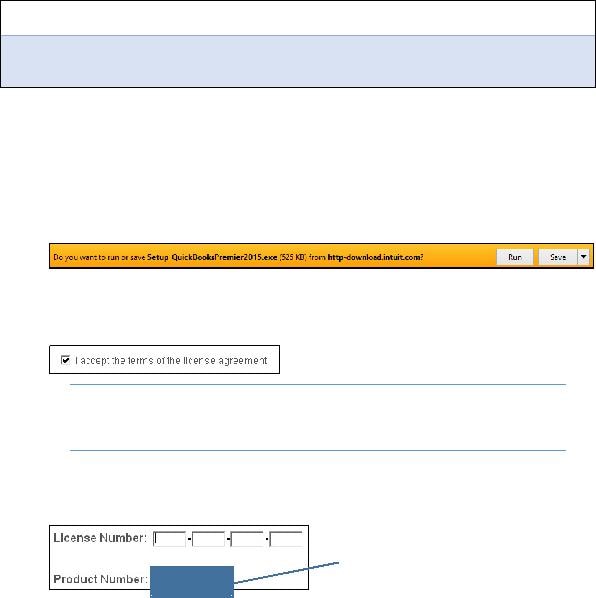
4.Choose the Run option in the download bar, and then choose Yes in the dialog box that appears.
Continue with the next step after the download completes.
5.Click Next in the wizard screen, and then click Next in the Intuit QuickBooks Installer window.
6.Click the checkbox to accept the terms of the license agreement; click Next.
Tip! If desired, use the Print link at the top‐right corner
of the window to print the License Agreement for your records.
7.Ensure that the Express (recommended) installation type is selected; click Next.
The Express installation will place QuickBooks in the default location on your computer.
8.Type your license number and product number in the provided boxes; click Next.
For QuickBooks 2014, use 602‐834.
For QuickBooks 2015, use 503‐153.
9.Click Install.
The installation can take time, so be patient!
10.Click Open QuickBooks in the screen that appears after the installation is complete.
11.If a notice regarding how QuickBooks uses your Internet connection appears, click OK.
The QuickBooks trial software is now installed on your computer.
12.Toggle to the Pro edition of the software, if necessary for your course.
B3n.hvr._1959-altadefinizione.cool_._1080p-hd-i... Today
Ben-Hur was a massive gamble for MGM, which was facing bankruptcy at the time. Its overwhelming success saved the studio and set a standard for "event" filmmaking that influenced future directors like Steven Spielberg and George Lucas. It held the record for the most Oscar wins alone for nearly 40 years until it was tied by Titanic (1997) and The Lord of the Rings: The Return of the King (2003).
However, the film’s subtitle, "A Tale of the Christ," points to its true thematic resolution. Judah’s path repeatedly crosses with Jesus of Nazareth, moving the story from a cycle of Roman violence and revenge toward a message of Christian forgiveness and redemption. Technical Prowess: The Chariot Race B3n.Hvr._1959-Altadefinizione.cool_._1080p-HD-i...
At its core, the film is a deeply personal story set against a monumental historical backdrop. It follows Judah Ben-Hur, a Jewish prince who is betrayed by his childhood friend, the Roman Messala. The narrative arc takes Judah from a life of nobility to the grueling existence of a galley slave, fueled entirely by a desire for vengeance. Ben-Hur was a massive gamble for MGM, which
Directed by William Wyler and starring Charlton Heston, Ben-Hur remains one of the most significant achievements in film history, particularly noted for its scale, its record-breaking 11 Academy Awards, and its legendary chariot race. The Epic Scale of Ben-Hur (1959) However, the film’s subtitle, "A Tale of the
The 1959 version of Ben-Hur represents the pinnacle of the "sword-and-sandals" epic. At the time of its release, it was the most expensive film ever made, with a budget of approximately $15 million. This investment is visible in every frame, from the massive sets constructed at Cinecittà Studios in Rome to the thousands of extras used to populate the streets of Jerusalem and the Roman arenas. Themes of Revenge and Redemption
No discussion of Ben-Hur is complete without the chariot race. Even by modern standards, the sequence is a marvel of practical filmmaking. It took nine months to plan and ten weeks to shoot, utilizing 82 horses and a 18-acre track. The lack of CGI means the tension and physical danger felt by the audience are grounded in real-world physics, making it one of the most visceral action sequences ever put to film. Legacy and Impact
Ben-Hur was a massive gamble for MGM, which was facing bankruptcy at the time. Its overwhelming success saved the studio and set a standard for "event" filmmaking that influenced future directors like Steven Spielberg and George Lucas. It held the record for the most Oscar wins alone for nearly 40 years until it was tied by Titanic (1997) and The Lord of the Rings: The Return of the King (2003).
However, the film’s subtitle, "A Tale of the Christ," points to its true thematic resolution. Judah’s path repeatedly crosses with Jesus of Nazareth, moving the story from a cycle of Roman violence and revenge toward a message of Christian forgiveness and redemption. Technical Prowess: The Chariot Race
At its core, the film is a deeply personal story set against a monumental historical backdrop. It follows Judah Ben-Hur, a Jewish prince who is betrayed by his childhood friend, the Roman Messala. The narrative arc takes Judah from a life of nobility to the grueling existence of a galley slave, fueled entirely by a desire for vengeance.
Directed by William Wyler and starring Charlton Heston, Ben-Hur remains one of the most significant achievements in film history, particularly noted for its scale, its record-breaking 11 Academy Awards, and its legendary chariot race. The Epic Scale of Ben-Hur (1959)
The 1959 version of Ben-Hur represents the pinnacle of the "sword-and-sandals" epic. At the time of its release, it was the most expensive film ever made, with a budget of approximately $15 million. This investment is visible in every frame, from the massive sets constructed at Cinecittà Studios in Rome to the thousands of extras used to populate the streets of Jerusalem and the Roman arenas. Themes of Revenge and Redemption
No discussion of Ben-Hur is complete without the chariot race. Even by modern standards, the sequence is a marvel of practical filmmaking. It took nine months to plan and ten weeks to shoot, utilizing 82 horses and a 18-acre track. The lack of CGI means the tension and physical danger felt by the audience are grounded in real-world physics, making it one of the most visceral action sequences ever put to film. Legacy and Impact